Wednesday, November 13, 2013

Fence Dreaming


We wished for a front fence for several years. The Garden of Nemesis would be prettier framed and maybe those who used our garden for a cut-through to the alley would get the message that after eighty-some years vacant, this city lot was now occupied. Despite the easy maintenance we didn’t want plastic, heaven forbid. We wanted picket, but not straight and severe and certainly not white. We bought fencing and my husband customized the pickets according to his imagination. 
POSTS ON GROUND AWAITING PLACEMENT

We finally built the fence in 2005.
 THIS IS BEFORE THE FRONT YARD AND THE "ONE TREE GARDEN" WAS PLANTED
We were right in that it beautifully framed the garden and the foot-traffic began to respect the boundary. Unfortunately, we assumed that to make it secure, we should add cement to the holes; maybe in the Arizona desert, but not in northern Illinois, as it collects moisture and contributes to rot. 

2006 BIRDS NEST TREE PLANTED INSIDE LIMESTONE


We had a lot of snow in 2010, and the speeding snowplows threw the heavy wet mess against the fence, taking a section down. It was no fun digging out the old cement. We made a new section.

SNOWPLOW DAMAGE 2010

In 2012, when the street was unexpectedly icy, a driver took out another section. At least it wasn’t the same area. We have now corrected our mistake and replaced all of the sections, sans cement. 

NOVEMBER 2012

Once again, The Garden of Nemesis has her lovely frame.


Tuesday, November 12, 2013

Coping With Darkness


The garden is getting drowsy. Soon it will sleep under a blanket of snow. The soil has been augmented with whatever organic material at hand and little critters such as earwigs and earthworms are still rather close to the surface, eating and excreting. The garter snakes are already snoozing. The squirrels are busy digging holes in the lawn to bury winter eats. The cats are getting fat and furry. Most of the birds in The Garden of Nemesis are regulars who will entertain us at the feeders all winter. It is dark.
BIRDS NEST TREE IN "ONE TREE GARDEN"

 It is the darkness, the lack of sunlight, that places the burden of lethargy upon my body. My metabolism slows down and I crave fats and sugar to convert to fat. I want hot chocolate. I want to sleep, to hibernate. That’s fine for the young, but for us older folks, to stop, even temporarily, is to seize up. I must retrieve my yoga mat. And get out my sculpting materials and tools. 

 I only sculpt in the dark of winter. When the days get longer again and the snow melts and I can see that the tulips and daffodils are sending up shoots through the soil, I begin to wrap up that particular type of art. Usually by this time in the spring I have the bedding plants underway, and their care is all-consuming. For a small donation, my friends contract with me to start their future gardens. My little gas range holds cookie sheets filled with germinating seeds. After they poke through the soil, they’re moved to the enclosed porch to sunbathe. I’ve discovered that starting plants inside is as much an art as sculpting; an art that takes dedication and finesse.

The little seedlings are much like human infants in they can’t always tell you what they need, you must anticipate their requirements. If they are too wet or too dry, or don’t get enough light, they may end up in the compost. Not only that, but one must also plan far ahead for the exact plants that may be needed. I always end up donating leftovers to the neighborhood food bank. I have been known to crowd in a few of these babies that were not in my original plan. This year it was celery and cucumbers.

The first two bush cucumber plants I set out early sickened and died. On the other hand, the two latecomers I had reluctantly stuck in a corner produced bushels of cukes, which were spread around the neighborhood for salads, pickling and juicing. I even froze Ziplocks filled with the blended nectar of cukes. I retrieved a bag the other day and used its contents in a slushy apple drink. Just thinking of the miracle of germination and nurturing those small green sprigs of life, well, it lifts my spirits in the dark days of winter.

Wednesday, November 6, 2013

How I Made Quince Preserves


Step #1 Find the fruit

Back in September, I wrote about the surprise and wonder of discovering the bushes I had planted in 2002 were flowering quince and on how I wished to do a little urban foraging on the university grounds from which they came. Well, a few days ago, we did.

It was in the low fifties and spitting rain as we donned wellies and slickers. When my sweet husband asked me why we were doing this in the rain I said, “Because it’s now a choice between relatively warm rain and utter cold. We’ve already had a handful of nights in the mid-twenties and if there are quinces out there, the woods may have cooled enough to freeze them the very next time. Besides, it’s not really raining.” He raised one eyebrow.

We took along a medium-sized backpack I had lined with a tall, skinny cardboard box (in case the fruit was mushy) and several plastic grocery bags tucked into the pocket. We entered university property via a back road and drove through the woods close to the place where we remembered digging the little suckers that were to become our beautiful flowering quince bushes. Jorge interrupted my pleasant reverie with, “Let’s go to Security and let them know what we’re doing.” I told him he really knew how to take the fun out of foraging. In the end, I didn’t argue, as I didn’t want getting shot at to be Step #2 in the process of making quince preserves.

About that time, we spotted the white car with the university logo on its door. We pulled up alongside and I explained I was alumni and we were looking for quinces. I was surprised by the initial fear in his eyes and he was surprised that two nutcases wanted to get wet hunting for, what? We parked the car in a far-flung lot and took the first path that presented itself. As we entered this parallel world, I told Jorge to look back into the shrubbery for yellow globes. Goes to show you what I know.

GARDEN OF NEMESIS MAPLE TREE 2013

It wasn’t long before the trail split and narrowed and we found ourselves on a deer path. Fallen leaves were slippery underfoot as it drizzled and dripped from above. In the distance we could hear traffic, but it seemed far removed from this woodland paradise. Suddenly, we entered a maple tree colony and were bathed in buttery diffused light. We stood in silent marvel. The canopy was a ceiling of bright yellow.

In the other world of debt ceilings and government shutdowns and unemployment and random shootings and GMOs and chemtrails and nuclear waste leaking into the ocean and atmosphere…well, Mother Nature teaches us how to go on. No matter how ruthlessly and thoughtlessly her children treat her sacred gift, she keeps selflessly giving.

It wasn’t long after that when we stumbled upon the fallen crop of a quince tree, said to be not as tasty as the fruit of the quince bush. We gathered about fifty quinces that were not yellow and certainly not mushy; they were greenish yellow-brown, hard as rocks and not one was bigger than a tennis ball.
For the rest of the hike, we were reasonably satisfied our romp in the woods was not just fun, but practical. We never came across the quince bushes and the rain became soaking, so we reluctantly made our way to the car.

Upon arriving home, I immediately washed my little treasures. Did I take any photos? Sorry, I forgot in all the excitement. Now for

Step #2 Decide what to make from the fruit

I had collected several recipes from the internet, but all of them involved peeling and chopping. These things are hard and I simply wasn’t up to it, as I still had a load of apples to process. The apples, in fact, gave me the idea to make quince butter.

Step #3 Quarter the Fruit and Put it on to Boil

I used one of my good jelly pots and set the quinces to boil. After two hours, I deemed the fruit soft enough to put through the Foley Food Mill. I realize most kitchens aren’t equipped with one of these handy devices. According to E How, “A food mill is a utensil used for mashing and sieving various foods. It should be used for foods that require impeccable smoothness. The food mill outdates many of its contemporary competitors, such as the food processor or blender. Though this hand-operated kitchen tool may seem a bit archaic, it offers a quality of food that many other appliances cannot.”


Step #4 Foley Food Mill the fruit

A guy from Minnesota patented this mill in 1933 and my mother had one, which she considered very modern. I bought one at a garage sale years ago, although they’re not expensive to buy new. This food mill wastes nothing, which is handy when you have very little of the food you’re processing. It catches and sifts out seeds, cores, fibers and skin, leaving a perfectly smooth sauce. Using a blender or food processor requires you to remove unwanted pieces of produce yourself, or grind them up, so it’s a time saver in the end.

Quinces are seedier than apples, thus harder to mill and more time consuming. When I finished this task I had about three quarts of sauce.

Step #5 Put back on the stove to cook down

I used the same pot to cook down the fruit, as my other one was filled with quartered apples already cooking. Cooking down any fruit takes time and patience. Both quince and apple sauce need no pectin in order to “jell,” they are full of it. I added a few shakes of clove powder as I could always add more later to taste. I also threw in a couple cups of sugar. I added a third cup later as I determined it was not sweet enough. The burner must remain on low and this has to be stirred often. A good jelly pan will ensure it does not stick and scorch.

As it cooked, a wonderful aroma filled the house. It began to change color; it went from beige-brown to a deep, rich burgundy color. The taste was just as heavenly. It had evaporated about one third of its mass and finally sheeted off the spoon and was ready to jar.

Step #6 Jar and process

The jars and lids were hot and sterile, so I filled them with the precious quince “butter”; it yielded nine half pints. The jars went back into the canner to boil for another ten minutes. When the timer went off, I lifted the jars onto a thick towel on the counter and, with the taste of quince still in my mouth, stood for a moment to admire my work. It was good.


Saturday, October 26, 2013

Hugelkultur


Another gardening season has ended. Sort of. As most of us gardeners know, next year’s garden is greatly influenced by what we do now. Many trees and shrubs are best trimmed after the leaves fall, compost is built, fallen leaves are swept up and maybe placed as insulation in strategic locations. I always feel kind of sad in the fall.

My friends remind me that it is a “falling asleep” as opposed to a “dying”. Tell that to my gargantuan tomatillo plant I just threw onto the newly built hugel. Yes folks, I’m finally dipping my toe into hugelkultur. Were it not for the internet, I would never have known about this ancient method of gardening; no one around here is talking about it and I have never seen it.
 Digging the Hole 

In my opinion, Hugelkultur is really not a very attractive system viewed from the ground. I’ve seen photos of it from the air and it’s beautiful if designed properly. I wish for beauty and symmetry, not some messy-looking hill. My little experiment back by the garage is bound to be viewed by a parade of visitors and I want to put hugelkultur’s best foot forward, so to speak. That’s why I didn’t build it directly on the ground.

When a hugel is built on top of the ground, it’s tall, which I think would be out of proportion in the little space I have out back. Thus, I dug down about the length of my spade. I threw the top soil to the sides to be replaced later. It’s good top soil, as I’ve spent a dozen years constructing that loam, which used to be pure clay and other crap that they used a century ago to fill the lot. After digging the hole, we sorted through an old firewood pile and threw the “refuse” into the bottom. Next, I piled on some grass clippings and kitchen scraps I had saved, with the intention of “jump-starting” the decomposition process. Now I’ve begun to add whatever plants that have died back from the frost. Soon, it will be leaves and more green stuff. I’m not as picky here as I would be if it were an ordinary compost pile. 


 Good Stuff I Saved to Jumpstart
            I do not allow weed and other seeds into the compost pile. Sometimes the pile gets hot enough to debilitate the seeds, sometimes not. I hate to end up actually planting stuff I don’t want in with my vegetables as I spread the compost. I also keep sticks and branches out of the compost as it takes so long to break down. In the case of the hugel, I can use a lot of the refuse I normally put out for recycling. That makes me happy. 
 Adding the Wood


            What doesn’t make me happy s how tall the pile is getting. I’m wondering if I have enough dirt set aside to cover it. Compost will have to be added later. I refuse to buy dirt, so I will have to let it “settle” over the winter and hope for the best. According to experienced hugelkultur gardeners, the first year one can see little benefit to this method. Starting the second year, when the wood begins to break down, it acts as a sponge, absorbing rainfall and eliminating the need for watering. The temperature of the hugel will be several degrees warmer than regular garden soil, thus extending the season.
 Piling It On


Besides eliminating the need to water and a higher soil temperature, other benefits to hugelkultur is a constant fertilization and small air pockets. As the plant roots reach down, they gather nutrients and have free reign to spread and stretch. That makes for bigger and healthier plants. For those who are worried about CO2, the hugel will not emit that gas as will a compost pile. As I am building this hugel, I can’t help but remember our “accidental berm,” which I wrote about in an earlier post.
Spent Grape Vines On Top


The plants on the berm went wild for the first several years. I deducted it was all the sod mixed in with the soil that had been moved there. The chrysanthemums I planted in the fall of 2001 were absolutely huge the next year. Every year they got a little smaller as the decomposing sod fertilizer fizzled out. I so wish I had made a big hardwood pile underneath that thing; I would not have to water out there, even to this day. Well, so goes gardening. By the time we are expert at the art of innovation, we’re too decrepit to implement ideas! That is why it’s so important to share information and to mentor the next generation. Gardening is always exciting, and trying new things makes it all the more interesting.

Yes, another gardening season has ended and soon snow will blanket my new hugel, adding to the mystery of what is to come. Even though I always feel kind of sad in the fall, I can look out my window this winter with the knowledge super potatoes will soon grow on that little hill back yonder.

Thursday, October 3, 2013

Stop and Smell the Pumpkins

Pumpkin Bloom 2013


I just sent out the invitations to the “First Annual Harvest Celebration and Jelly-Tasting” to be held here at the Garden of Nemesis on October 12th. Hey, they have wine-tasting parties, why not jelly-tasting? Any excuse for a party.

Pumpkin Vine Climbing the Arborvitaes 2013
I have invited about fifty of my friends from near and far with an RSVP attached. So far, a half dozen have said to expect them. In the end, I’ll be very satisfied if twice that many show up. One of my gracious friends said she’d provide the waffle iron and a recipe to go with it; I intend to take her up on the offer. It’s an opportunity to share my preserves and strengthen new and old friendships over coffee and conversation.
 Still Climbing

Opening the Garden of Nemesis to the public has opened unexpected doors. I’ve met some very interesting and wise characters. I thoroughly enjoy the company of other gardeners and plant lovers. Our common bond is a love of Nature and the Earth and our eagerness to share our knowledge. We never run out of things to talk about, only the time in which to do so.

This is the time of year where most gardeners are frazzled. Housekeeping chores get put off while we weed, distribute compost, plant ground cover, wash and preserve fruits and vegetables and move tender plants inside before the frost. It’s generally a mess around here this time of year. Luckily, my friends don’t mind a few cobwebs in my less-than-perfect house; they’ve already seen the worst when they’ve unexpectedly dropped by.
Still Climbing

The main focus for this gathering is to celebrate life and friendships and abundance. Sometimes we get so caught up in our everyday toils we forget to stop and smell the pumpkins.


Sunday, September 22, 2013

Food for Thought: Conversations with Your Gut


According to researchers of “mental illness,” We the People of the United States are swimming in a vast and deep lake of depression and other mental “disorders”. Some call it an epidemic and blame psychiatric drugs. Some say it’s a full-blown “rebellion” against modern life and its dictates. Others claim it’s linked to genetically modified food and nutritional deficiencies. I’ve even read that the bombardment of radio and other invisible waves affect our brains. It may be that we are getting clobbered from multiple sources. Even to a layman such as me, it’s obvious the world is going bonkers.

When I first began working in the Garden of Nemesis in 2001, I noticed people walking down the street talking to what appeared to be—themselves. Nowadays they have cell phones or headsets embedded in their ears but nonetheless, are still conversing.  I honestly can’t see the difference.

The truth is there is a lot of pain and suffering going on. I, too, once endured the depression malady; I was in my early forties before it became clear I had had this chronic condition ever since I could remember. It was so chronic that I considered it my “normal” state of mind. Alcohol and other self-medications had once helped, but by my late thirties it became clear that what I was using to treat my condition had themselves become a problem. It was time for a lifestyle change.

This huge change began to work its magic when I stopped self-medicating and got into psychotherapy and AA. Really, it was a good thing I could not see into the future, because things got much worse before they started to get better. I alternated between crying jags and frantic rages for the first sober year. Many details of my childhood began to surface and I began to perceive just how screwed up my thinking had been. In the second year of my sobriety, I experienced my first moment of bliss while driving my old pickup truck on a Mississippi back road. Perhaps I had had this experience as a child, because it seemed vaguely familiar.

After that first glimpse of joy, I began to realize I had truly been “out of my mind” and my body for most of my past. I knew in my gut, in my “second brain,” that even though others may have caused my childhood damage, I alone was responsible to facilitate my own healing.

Children have the amazing capacity to lock away fears and demons into the dark recesses of the mind, otherwise they may not be able to survive the growing-up process. As an adult, it was up to me to deal with these fears and demons, otherwise my soul could not reach anything close to maturation. I reached out for help during this process and miraculously attracted just the right people who could help me. Some were professionals; others were those who had had similar experiences.

During the many years of my therapy, several doctors tried their best to get me to take medication. I believed, and still do, that in my case, chemistry had failed to bring adequate results and I needed to simply unlock the horrific and repulsive memories and allow myself to feel their true impact; then, and only then, would I be free of the daily, albeit unconscious, forays into the nightmare that was my childhood. My instincts were right.

One of the many transformations that occurred during this healing period was that I began to listen to my gut, my instincts. Amazingly, this ability still existed within me even though it had been suppressed and squashed for decades. It wasn’t until recently that I began to ponder the notion that gut feelings come from the same area as where I digest my food. Is there a link? Is consumed food communicating to my mind and body as it passes through?
Where and how had that animal on my plate been birthed and raised? Had that apple faced the sun naked or covered with toxins? What non-food substances had been added to that box or can? What kind of genes had been transferred into that fruit/vegetable seed before it was planted? Most importantly, is digestion more than a chemical process? Is some form of consciousness being communicated to my being as I digest this “food”?

It’s clear by the commercials on television that Americans are having digestive problems. Is there a relationship between the food that causes heartburn, acid reflux, constipation, diarrhea and colon cancer to—what? mental problems? If the gut is the seat of our instincts, our second brain, then what are all these non-food additives and GMOs doing to our thinking processes?

Richard Alan Miller has helped to educate me regarding the relationship of my gut and the food I eat. His research has yielded information that is not for the faint-hearted. If one is not open to changing one’s belief paradigm, this brilliant man’s material should be avoided. He has opened my mind to the possibility of “conversations” happening between myself and my gut. I am ever becoming aware of this ongoing communication between my Self and the sun, the plants, animals and even so-called inanimate rocks and soil.

Every day as I work or play in my garden, I have conversations with my environment. I am but a small link in the incredible Chain of Life. Each of us is as important as any other of the individual parts, and we all make up the whole; a whole linked not just in the physical, but in mind and spirit. Just as I am clearly conscious of my own suffering, I am aware of the pain of others. However, pain and suffering are not meant to be a way of life.

Pain gets our attention, points out that a problem exists; pain is an opportunity to make corrections. I’m sorry to say that nothing and no one can “fix” us from the outside. It’s an inside job. The buck stops here. Yes, the world is going bonkers and looking for cures in all the wrong places.


Thursday, September 19, 2013

Mornings in the Kitchen


Mornings in the kitchen have replaced mornings in the garden this August and September. Not every morning, but enough to make me long for that sweet spot on the bench by the berm.
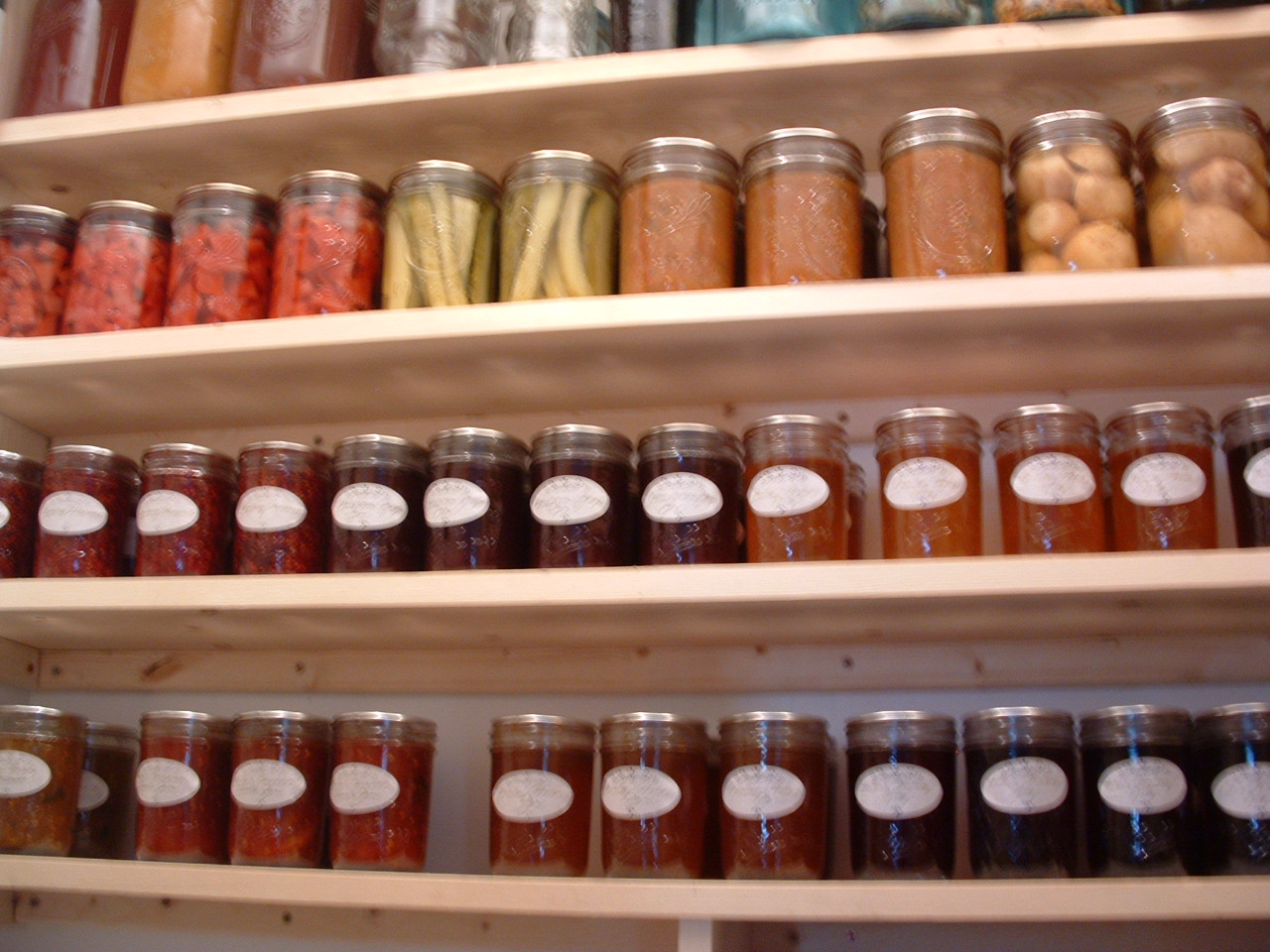
Well, it can’t be helped. The garden produce is ripe and must be canned, frozen, dehydrated or fermented. I do so with a thankful heart. There’s nothing more lovely than pantry shelves that display the ultimate results of my hard work.

Sometimes I trace the beginnings of the fruit or vegetable I am processing: the saved seed, its first contact with soil and its miraculous germination, the moment when it first pokes its tiny head above ground. I remember how it leaned towards the light streaming through the sun porch’s wide widows. It must been the largest and healthiest to have escaped the several thinnings and cullings.

The bedding plant stretches itself further as it is transferred to a bigger pot and then, about the time the tulips bloom, to the potting shed.
Sometime in late May or early June, it is moved to the garden, where it is dropped into a composted hole or trench. It may have felt the weight of a fabric cover if frost was expected. Finally, it grows out of its babyhood and becomes largely self sufficient, competing with other plants for water, nutrients and light.

The growing plant feels the weight of my footsteps and the sound of the hoe and of course, my voice as I exclaim how beautiful it is. Some of these developing plants are staked and/or tied to further facilitate the eventual harvest. Some of this harvest is from seeds direct sowed into the garden plot.

The garden plot has expanded itself into so-called flower beds. A dozen or so years ago, I began to restructure my belief paradigm about where plants should grow. The truth is, they should grow wherever there is room and they’re happy. A baby tomatillo had no space when it came time to plant it, so its home has been in the new strawberry bed.
It remains to be seen what has transpired underneath its gargantuan limbs full of hanging fruit. I’m sure the strawberry plants will recover in the spring.

Many herb plants such as feverfew, cilantro and chamomile grow proudly in my cottage garden, with passersby none the wiser. Chives and fragrant basil and thyme have escaped the formal vegetable garden and may be found in divers places. Aji Dulce peppers grow in pots to be overwintered in the house, as does the Medusa ornamental.
Ripening Medusa Peppers

Who knew peppers could survive in a window sill only to be set out in the spring for another season of production?
Aji Dulce in the house in November 2012
 Same Aji Dulce in the garden August 2013
Rosemary and lavender have also flourished in their pots and are natural home air fresheners.

Soon all the pots will come in the house, which is a task I dread. A few tropicals have gotten so big they are permanent fixtures, destined to never move again. 
Our Live Christmas Tree

Sometimes I complain about the care these suddenly-indoor plants require. The truth is I generally enjoy picking off dead leaves and watering these guys. I can have a little taste of summer even as I watch the snow fly outside the windows. All those mornings in the kitchen and the garden will be appreciated as, instead of eating supermarket garbage, we eat the superb food I have grown and preserved with my own hands.