Saturday, October 26, 2013

Hugelkultur


Another gardening season has ended. Sort of. As most of us gardeners know, next year’s garden is greatly influenced by what we do now. Many trees and shrubs are best trimmed after the leaves fall, compost is built, fallen leaves are swept up and maybe placed as insulation in strategic locations. I always feel kind of sad in the fall.

My friends remind me that it is a “falling asleep” as opposed to a “dying”. Tell that to my gargantuan tomatillo plant I just threw onto the newly built hugel. Yes folks, I’m finally dipping my toe into hugelkultur. Were it not for the internet, I would never have known about this ancient method of gardening; no one around here is talking about it and I have never seen it.
 Digging the Hole 

In my opinion, Hugelkultur is really not a very attractive system viewed from the ground. I’ve seen photos of it from the air and it’s beautiful if designed properly. I wish for beauty and symmetry, not some messy-looking hill. My little experiment back by the garage is bound to be viewed by a parade of visitors and I want to put hugelkultur’s best foot forward, so to speak. That’s why I didn’t build it directly on the ground.

When a hugel is built on top of the ground, it’s tall, which I think would be out of proportion in the little space I have out back. Thus, I dug down about the length of my spade. I threw the top soil to the sides to be replaced later. It’s good top soil, as I’ve spent a dozen years constructing that loam, which used to be pure clay and other crap that they used a century ago to fill the lot. After digging the hole, we sorted through an old firewood pile and threw the “refuse” into the bottom. Next, I piled on some grass clippings and kitchen scraps I had saved, with the intention of “jump-starting” the decomposition process. Now I’ve begun to add whatever plants that have died back from the frost. Soon, it will be leaves and more green stuff. I’m not as picky here as I would be if it were an ordinary compost pile. 


 Good Stuff I Saved to Jumpstart
            I do not allow weed and other seeds into the compost pile. Sometimes the pile gets hot enough to debilitate the seeds, sometimes not. I hate to end up actually planting stuff I don’t want in with my vegetables as I spread the compost. I also keep sticks and branches out of the compost as it takes so long to break down. In the case of the hugel, I can use a lot of the refuse I normally put out for recycling. That makes me happy. 
 Adding the Wood


            What doesn’t make me happy s how tall the pile is getting. I’m wondering if I have enough dirt set aside to cover it. Compost will have to be added later. I refuse to buy dirt, so I will have to let it “settle” over the winter and hope for the best. According to experienced hugelkultur gardeners, the first year one can see little benefit to this method. Starting the second year, when the wood begins to break down, it acts as a sponge, absorbing rainfall and eliminating the need for watering. The temperature of the hugel will be several degrees warmer than regular garden soil, thus extending the season.
 Piling It On


Besides eliminating the need to water and a higher soil temperature, other benefits to hugelkultur is a constant fertilization and small air pockets. As the plant roots reach down, they gather nutrients and have free reign to spread and stretch. That makes for bigger and healthier plants. For those who are worried about CO2, the hugel will not emit that gas as will a compost pile. As I am building this hugel, I can’t help but remember our “accidental berm,” which I wrote about in an earlier post.
Spent Grape Vines On Top


The plants on the berm went wild for the first several years. I deducted it was all the sod mixed in with the soil that had been moved there. The chrysanthemums I planted in the fall of 2001 were absolutely huge the next year. Every year they got a little smaller as the decomposing sod fertilizer fizzled out. I so wish I had made a big hardwood pile underneath that thing; I would not have to water out there, even to this day. Well, so goes gardening. By the time we are expert at the art of innovation, we’re too decrepit to implement ideas! That is why it’s so important to share information and to mentor the next generation. Gardening is always exciting, and trying new things makes it all the more interesting.

Yes, another gardening season has ended and soon snow will blanket my new hugel, adding to the mystery of what is to come. Even though I always feel kind of sad in the fall, I can look out my window this winter with the knowledge super potatoes will soon grow on that little hill back yonder.

Thursday, October 3, 2013

Stop and Smell the Pumpkins

Pumpkin Bloom 2013


I just sent out the invitations to the “First Annual Harvest Celebration and Jelly-Tasting” to be held here at the Garden of Nemesis on October 12th. Hey, they have wine-tasting parties, why not jelly-tasting? Any excuse for a party.

Pumpkin Vine Climbing the Arborvitaes 2013
I have invited about fifty of my friends from near and far with an RSVP attached. So far, a half dozen have said to expect them. In the end, I’ll be very satisfied if twice that many show up. One of my gracious friends said she’d provide the waffle iron and a recipe to go with it; I intend to take her up on the offer. It’s an opportunity to share my preserves and strengthen new and old friendships over coffee and conversation.
 Still Climbing

Opening the Garden of Nemesis to the public has opened unexpected doors. I’ve met some very interesting and wise characters. I thoroughly enjoy the company of other gardeners and plant lovers. Our common bond is a love of Nature and the Earth and our eagerness to share our knowledge. We never run out of things to talk about, only the time in which to do so.

This is the time of year where most gardeners are frazzled. Housekeeping chores get put off while we weed, distribute compost, plant ground cover, wash and preserve fruits and vegetables and move tender plants inside before the frost. It’s generally a mess around here this time of year. Luckily, my friends don’t mind a few cobwebs in my less-than-perfect house; they’ve already seen the worst when they’ve unexpectedly dropped by.
Still Climbing

The main focus for this gathering is to celebrate life and friendships and abundance. Sometimes we get so caught up in our everyday toils we forget to stop and smell the pumpkins.


Sunday, September 22, 2013

Food for Thought: Conversations with Your Gut


According to researchers of “mental illness,” We the People of the United States are swimming in a vast and deep lake of depression and other mental “disorders”. Some call it an epidemic and blame psychiatric drugs. Some say it’s a full-blown “rebellion” against modern life and its dictates. Others claim it’s linked to genetically modified food and nutritional deficiencies. I’ve even read that the bombardment of radio and other invisible waves affect our brains. It may be that we are getting clobbered from multiple sources. Even to a layman such as me, it’s obvious the world is going bonkers.

When I first began working in the Garden of Nemesis in 2001, I noticed people walking down the street talking to what appeared to be—themselves. Nowadays they have cell phones or headsets embedded in their ears but nonetheless, are still conversing.  I honestly can’t see the difference.

The truth is there is a lot of pain and suffering going on. I, too, once endured the depression malady; I was in my early forties before it became clear I had had this chronic condition ever since I could remember. It was so chronic that I considered it my “normal” state of mind. Alcohol and other self-medications had once helped, but by my late thirties it became clear that what I was using to treat my condition had themselves become a problem. It was time for a lifestyle change.

This huge change began to work its magic when I stopped self-medicating and got into psychotherapy and AA. Really, it was a good thing I could not see into the future, because things got much worse before they started to get better. I alternated between crying jags and frantic rages for the first sober year. Many details of my childhood began to surface and I began to perceive just how screwed up my thinking had been. In the second year of my sobriety, I experienced my first moment of bliss while driving my old pickup truck on a Mississippi back road. Perhaps I had had this experience as a child, because it seemed vaguely familiar.

After that first glimpse of joy, I began to realize I had truly been “out of my mind” and my body for most of my past. I knew in my gut, in my “second brain,” that even though others may have caused my childhood damage, I alone was responsible to facilitate my own healing.

Children have the amazing capacity to lock away fears and demons into the dark recesses of the mind, otherwise they may not be able to survive the growing-up process. As an adult, it was up to me to deal with these fears and demons, otherwise my soul could not reach anything close to maturation. I reached out for help during this process and miraculously attracted just the right people who could help me. Some were professionals; others were those who had had similar experiences.

During the many years of my therapy, several doctors tried their best to get me to take medication. I believed, and still do, that in my case, chemistry had failed to bring adequate results and I needed to simply unlock the horrific and repulsive memories and allow myself to feel their true impact; then, and only then, would I be free of the daily, albeit unconscious, forays into the nightmare that was my childhood. My instincts were right.

One of the many transformations that occurred during this healing period was that I began to listen to my gut, my instincts. Amazingly, this ability still existed within me even though it had been suppressed and squashed for decades. It wasn’t until recently that I began to ponder the notion that gut feelings come from the same area as where I digest my food. Is there a link? Is consumed food communicating to my mind and body as it passes through?

Where and how had that animal on my plate been birthed and raised? Had that apple faced the sun naked or covered with toxins? What non-food substances had been added to that box or can? What kind of genes had been transferred into that fruit/vegetable seed before it was planted? Most importantly, is digestion more than a chemical process? Is some form of consciousness being communicated to my being as I digest this “food”?

It’s clear by the commercials on television that Americans are having digestive problems. Is there a relationship between the food that causes heartburn, acid reflux, constipation, diarrhea and colon cancer to—what? mental problems? If the gut is the seat of our instincts, our second brain, then what are all these non-food additives and GMOs doing to our thinking processes?

Richard Alan Miller has helped to educate me regarding the relationship of my gut and the food I eat. His research has yielded information that is not for the faint-hearted. If one is not open to changing one’s belief paradigm, this brilliant man’s material should be avoided. He has opened my mind to the possibility of “conversations” happening between myself and my gut. I am ever becoming aware of this ongoing communication between my Self and the sun, the plants, animals and even so-called inanimate rocks and soil.

Every day as I work or play in my garden, I have conversations with my environment. I am but a small link in the incredible Chain of Life. Each of us is as important as any other of the individual parts, and we all make up the whole; a whole linked not just in the physical, but in mind and spirit. Just as I am clearly conscious of my own suffering, I am aware of the pain of others. However, pain and suffering are not meant to be a way of life.

Pain gets our attention, points out that a problem exists; pain is an opportunity to make corrections. I’m sorry to say that nothing and no one can “fix” us from the outside. It’s an inside job. The buck stops here. Yes, the world is going bonkers and looking for cures in all the wrong places.


Thursday, September 19, 2013

Mornings in the Kitchen


Mornings in the kitchen have replaced mornings in the garden this August and September. Not every morning, but enough to make me long for that sweet spot on the bench by the berm.
Well, it can’t be helped. The garden produce is ripe and must be canned, frozen, dehydrated or fermented. I do so with a thankful heart. There’s nothing more lovely than pantry shelves that display the ultimate results of my hard work.

Sometimes I trace the beginnings of the fruit or vegetable I am processing: the saved seed, its first contact with soil and its miraculous germination, the moment when it first pokes its tiny head above ground. I remember how it leaned towards the light streaming through the sun porch’s wide widows. It must been the largest and healthiest to have escaped the several thinnings and cullings.

The bedding plant stretches itself further as it is transferred to a bigger pot and then, about the time the tulips bloom, to the potting shed.
Sometime in late May or early June, it is moved to the garden, where it is dropped into a composted hole or trench. It may have felt the weight of a fabric cover if frost was expected. Finally, it grows out of its babyhood and becomes largely self sufficient, competing with other plants for water, nutrients and light.

The growing plant feels the weight of my footsteps and the sound of the hoe and of course, my voice as I exclaim how beautiful it is. Some of these developing plants are staked and/or tied to further facilitate the eventual harvest. Some of this harvest is from seeds direct sowed into the garden plot.

The garden plot has expanded itself into so-called flower beds. A dozen or so years ago, I began to restructure my belief paradigm about where plants should grow. The truth is, they should grow wherever there is room and they’re happy. A baby tomatillo had no space when it came time to plant it, so its home has been in the new strawberry bed.
It remains to be seen what has transpired underneath its gargantuan limbs full of hanging fruit. I’m sure the strawberry plants will recover in the spring.

Many herb plants such as feverfew, cilantro and chamomile grow proudly in my cottage garden, with passersby none the wiser. Chives and fragrant basil and thyme have escaped the formal vegetable garden and may be found in divers places. Aji Dulce peppers grow in pots to be overwintered in the house, as does the Medusa ornamental.
Ripening Medusa Peppers

Who knew peppers could survive in a window sill only to be set out in the spring for another season of production?
Aji Dulce in the house in November 2012
 Same Aji Dulce in the garden August 2013
Rosemary and lavender have also flourished in their pots and are natural home air fresheners.

Soon all the pots will come in the house, which is a task I dread. A few tropicals have gotten so big they are permanent fixtures, destined to never move again. 
Our Live Christmas Tree

Sometimes I complain about the care these suddenly-indoor plants require. The truth is I generally enjoy picking off dead leaves and watering these guys. I can have a little taste of summer even as I watch the snow fly outside the windows. All those mornings in the kitchen and the garden will be appreciated as, instead of eating supermarket garbage, we eat the superb food I have grown and preserved with my own hands.

Friday, September 13, 2013

Mom’s Recipe Box


I just ran across my mother’s little wooden recipe box. It seems to fade in and out of my life. This time, I actually took the time to look through it and organize its contents. I also added a few of my own handwritten recipes. Of course, I had to pause and contemplate her handwriting. I’m sure when she wrote those recipes she could not have imagined that someday in the far future her eldest daughter would stare in rapt attention at her cursive.

I just read where cursive handwriting is likely to die off, as the young have no use for it in our digital age. I imagine the teachers have lost heart at teaching it, too. In the 1950’s, we sat for hours a week at our desks made of real wood and practiced making perfect flowing loops. We felt we were joining the adult world and printing began to seem slow and cumbersome and childish. My mother’s cursive is near perfect.
 In my mother’s little recipe box are formulas for making cakes and pies and breads from scratch. I can recognize the contributions of her friends, some of which have their own personalized imprinted recipe cards. In some cases, Mom just gave her friend credit by writing her name on the top. Also tucked among the ruins of Mom’s culinary exploits are recipes snipped from old magazines, fragile with age. Most of them are not dated, but one is from “The Ladies Home Journal,” circa 1959. It must have been considered very precious to have been saved for that length of time. Thus, I carefully fold these relics back into their place, along with a handwritten note to my own daughter detailing the history of this special box and its contents.

The era of Mom’s Recipe Box seems to have passed. On the other hand, if I should ever be unable to boot up my computer, it is best kept in a safe place. I’ll keep cursive copies of special recipes inside, just in case. It’s likely my great granddaughters may puzzle over all those perfect flowing loops.


Monday, September 9, 2013

Mysterious Pink Flowering Shrub


Once in awhile something utterly amazing and astonishing happens in the garden. This one took my breath away! I’ll begin at the beginning:

In 2002, my husband and I were walking in a wild wooded area on the campus of a local university where I was taking classes. It was a beautiful, oddly warm day in late March, and we had been lured into the woods by several large, pink blooming bushes. The gnarly, thorny shrubs were laden with the most amazing fragrant flowers! We coveted this strange bush, so asked the groundskeeper if we could dig some suckers to take home. He laughed and gave his permission. When we came back with a spade and bucket a few days later, we dug five shoots for our vacant lot at home. I might also mention we dug a few other unknown shrubs and a lilac that was no more than a twig. 
2011

 When we got home, I planted all the babies on the southwest corner of the lot on the far side of the berm. The shoots of the later-identified service berries took off, one of them growing over forty feet high in the next ten years…But back to our saga of the pink bloomer.

One of the five pink bloomers died; I mourned its passing. After about five or six years, the other four began to bloom in late March. This early blooming amazed me, so I began watching the shrub in winter. I discovered that the buds began to swell in January, when the ground was frozen solid and spring was just a dream. I took to garden walking in winter, using this still unidentified shrub as an excuse.
 2011
One garden guest identified the shrub as a flowering almond and I took her word for it until I was at a friend’s house in 2011. Connie was showing me her flowering almond and it was a completely different plant! I asked her how sure she was, and she said 100%. Now my curiosity was peaked and I decided to research on the internet. It’s hard to find something when you don’t know its name, but I came across the flowering plum and it looked similar. I was once again sort of satisfied.
2013

 Meanwhile, the bushes became scraggly tangles of thorny branches; big and ungainly, as we stopped pruning them. I had noticed that the blooms diminished after we trimmed. The neighbor told us the corner bush made backing out of her driveway a hazard, so Jorge removed it in 2010. Now we were down to three, although shoots still appear where the old bush once stood.

Yesterday, we were back in that corner trimming the service berry when I looked into the bush and saw an apple stuck to one of the branches. A second apple was on another branch. Being the idiot I sometimes am, I said, “What’s that?” and grabbed both of them. My husband and I examined this mystery. They were green and hard with the size and appearance of a small apple. It was then I fully became conscious of the fact this guy was no flowering plum.

When I got into the house, I cut one in half and examined its interior. It looked very similar to an apple in that it was full of pips. A plum would have had one pit. After a half hour on the internet, I discovered we had three flowering quinces, whose fruit makes absolutely delicious jams, jellies and marmalades! Now I’m thinking about asking the university groundskeeper if I can wander the woods to pick quinces in another few weeks.
Quince Photos (taken24 hours after cutting, thus browned interior)

Now that we have identified this mysterious shrub, we know to prune the dead wood in April, immediately after it blooms. I can put up with the unremarkable foliage and the thorns knowing that March will bring all those lovely blooms and October a luscious fruit for preserves. 

Wednesday, September 4, 2013

A Picture is Worth More Than a Thousand Words


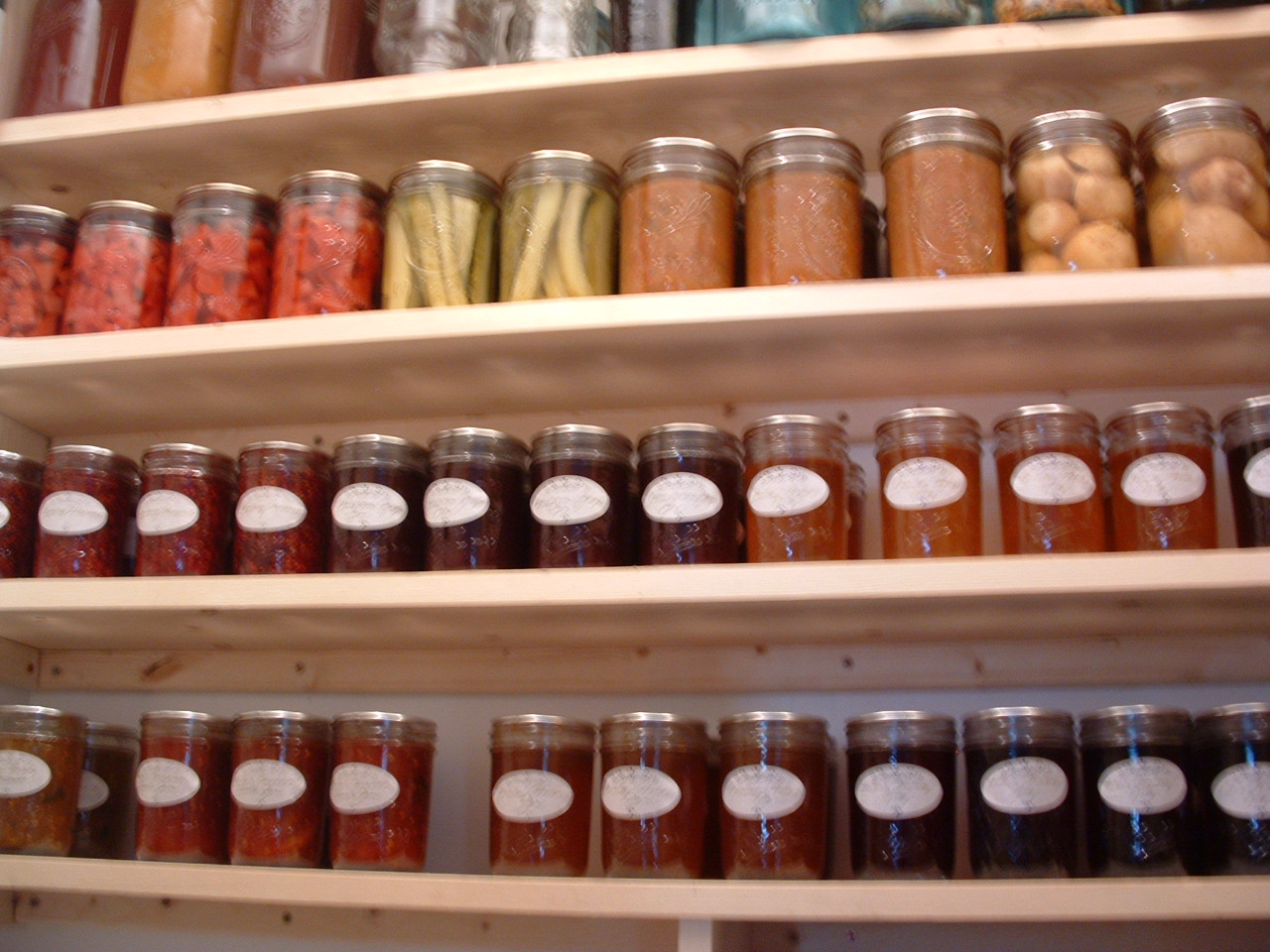
I’ve been harvesting and preserving for the long winter ahead.

From left to right: pumpkin, grape juice, strawberry juice, beets, pickles, salsa, potatoes, jams, jellies and marmalades.


I’m so happy to see the grapes, which went a little crazy this summer, off the vines and on the pantry shelves.
Grapes on Pergola 2013 

Grapes in progress on potting shed


 Grape Processing 2013


The pumpkin vine looked sick and stressed, so we harvested the eight little pumpkins.


Next on the to do list is to begin harvesting tomatillos from my one huge, sprawling plant. This is the first year I've grown them and know only what my neighbor has said and what I've learned in the internet. I found several recipes for preserves that I intend to try. I'm going to make green salsa to can that will heat up those cold winter snacks. More on tomatillo adventures later...

Tomatillo Plant 2013